Traditional Chinese Medicine in Lung cancer care after chemotherapy: A case report.
By Chiraphorn Bangsriwong, LAc.
Abstract
Chemotherapy treatment can cause unpleasant side effects. Fatigue is one of the most common side effects of chemotherapy, which also include nausea, hair loss, anemia, loss of appetite, insomnia, and anxiety/depression. Traditional Chinese medicine (TCM) can be effective in boosting energy and immunity and been shown to reduce adverse effects of chemotherapy such as fatigue, nausea, and vomiting. This is single case study of a 61-year-old female patient with 6 years of Cervical cancer and 3 years of lung cancer. This patient received acupuncture and Chinese herbal medicine for total of 10 treatments over a period of two months. After the second treatment, the patient’s appetite increased, and fatigue reduced significantly. Herbal remedies and acupuncture can be helpful for cancer patients to support their quality of life as they endure the side effects and toxicity of chemotherapy treatment.
Key words: Acupuncture, Chemotherapy, Lung cancer
Introduction and Biomedical Perspective
Cancer is the rapid creation of abnormal cells that grow beyond their usual boundaries, and which can then invade adjoining parts of the body and spread to other organs; the latter process is referred to as metastasis. Widespread metastases are the primary cause of death from cancer (Organization, 2022). The American Cancer Society’s estimates for lung cancer in the United States in 2022, new cases 236,740 separate in men 117,910 and woman 118,830. About 130,180 deaths from lung cancer. The 2 main type of lung cancer are non-small cell lung cancer (NSCLC) and small cell lung cancer (SCLC). (NSCLC) accounts for approximately 85% of all subtypes. SCLC constitutes approximately 15% to 25% of all lung cancers. Only 13% of all patients with lung cancer are expected to live 5 years. However, the risk factors are tobacco use, secondhand smoke, occupational, dietary, and familial/genetic. Lung cancer is the most preventable cancer. Symptoms of lung cancer depend on the type of tumor, its location and what the way it spreads. The main presenting system is usually a persistent cough or chest pain, weight loose, lassitude and wheezing.
The standard treatment of NSCLC has achieved extraordinary clinical results based on the surgery, radiotherapy, chemotherapy, targeted therapy, and immunotherapy, etc. However, the normal cells can be damaged by chemotherapy are blood-forming cells in the bone marrow, hair follicles, cells in the mouth, digestive tract, and reproductive system. Some chemotherapy drugs can damage cells in the heart, kidneys, bladder, lungs, and nervous system (team, 2022).
In Traditional Chinese medicine (TCM), Lung cancer translate as Fei Ai. According to TCM theory, lung cancer is included under the categories describing "lung-masses", "expanding-masses", "cough", "cough blood" and “chest pain". Several ancient medical books refer to it. For example, in "Summary from the Golden Chest” (Han Dynasty 206-220AD) under the five organs section, it states "the [lung] mass cannot be easily removed." In the Huang Di Nei Jing Su Wen, another famous book written during the Han dynasty, it refers to "difficult breathing [with lung cancer] without having difficult eating." TCM believes that lung cancer results from having a lack of healthy energy and from the accumulation of exogenous evils (outside influences that invade the body and cause illness). Lung cancer can be divided into 5 different syndromes including: 1. Yin Deficiency and Interior Heat Syndrome (The symptoms here include a cough without sputum or a cough with thick sputum). 2.Spleen Deficiency and Phlegm Dampness Syndrome (These symptoms include a cough that produces a great deal of sputum and chest tightness accompanied by shortness of breath.). 3. Deficiency of Qi and Yin Syndrome (These symptoms include a low and weak sounding cough, which produces a small amount of sputum which can be bloodstained). 4. Deficiency of Yin and Yang Syndrome. 5. Stagnation of Qi and Blood Stasis Syndrome (Yang Zhou, 2008). The most basic theory of TCM in the treatment of NSCLC is regulating the imbalance by "strengthening the body" and "eliminating evil" when the body’s immunity is too weak, and the tumor growth ability is too strong. "Strengthening the body" means enhancing the body’s anti-cancer immunity, while " eliminating evil " directly inhibits tumor cell growth, proliferation, invasion, and migration (Zhang Li, 2021).
Case History
61-year-old female patient with 6 years of Cervical cancer and 3 years of lung cancer. Fatigue (5 or 6 out of 10) after 3rd day after Chemotherapy, vomit without any substance, hair loss, nausea, loss of appetite, no energy to walk, shortness of breath, constipation, and sometime diarrhea. Moreover, the patient felt stress and reduced food intake, weight loss. History six years before her first visit, symptoms of white watery abnormal vaginal discharge led to diagnosis of cervical cancer. Treatment in southeast Asia for 6 months, followed by treatment in the US for another 2.5 years. Chemotherapy 1x/ month for 3 years until cancer-free, follow-up 3 every 3-6 months afterwards after 2.5 years, Lung cancer diagnosed, first year of chemotherapy fatigue for 7 days following each chemo treatment. Second year of chemotherapy fatigue for 15 days following each chemo treatment, with side effects of hair loss, low energy, and low appetite. After third year of chemotherapy, patient refused to continue but still follow-up with CT scan initially every 3 months. Currently June 2022 patient do CT scan and doctor find out the right lower lobe have new tumor appear and need to go back to do chemotherapy right aways on appointment of July 27th, patient feel sad and want to give up in life. Overall health condition are low energy stress and poor sleep, bowel movement and digestion abnormal, loose stool and next flowing days constipation, bloating after eating, no cough with blood, chest pain and wheezing.
Physical examination the patient’s pulse was thready, and weak. Tongue was pale narrow, toothmark, thin white coating. Palpation on the skin cool to the touch and other are dull pale complexion, spoke with a low voice.
Patient diagnosis and treatment
Traditional Chinese medicine and herb in treatment of lung cancer, the treatment efficacy is obviously higher, a harmonious combination with chemotherapy can increase the efficacy. Improvement in a lot of symptoms such as cough, coughing up of phlegm, fatigue, malnutrition etc. However, mitigate chemotherapy toxin induced reactions and improve patients’ quality of life. TCM will focus on treatment induced toxin of chemotherapy. The patient was diagnosed with TCM disease category fatigue (xu lao), TCM pattern of lung Qi deficiency, enduring cough with loose phlegm, shortness of breath. Also, TCM pattern of spleen Qi deficiency, reduced appetite, abdominal distention, and lack of strength in the limbs.
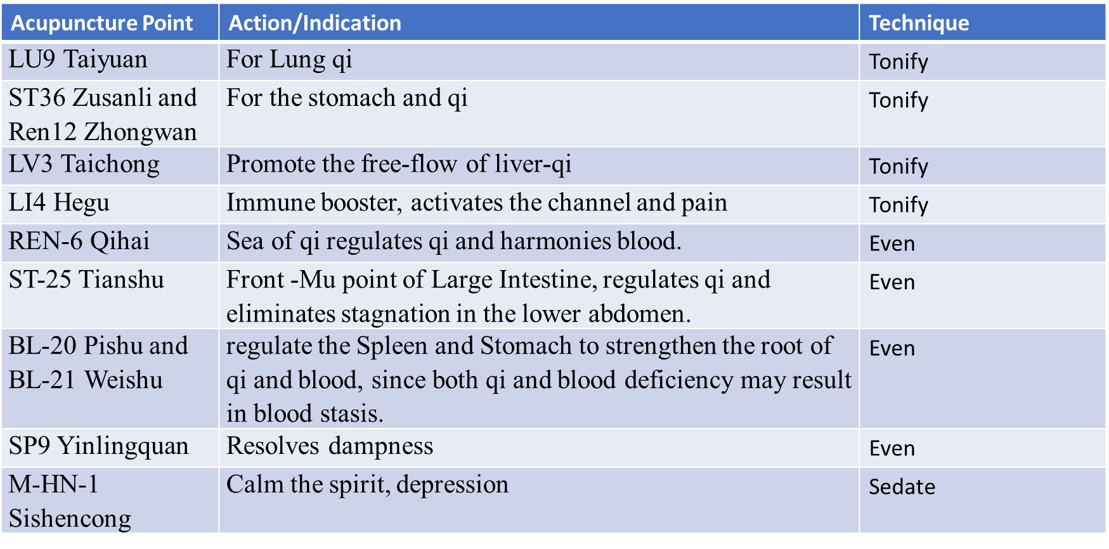
The treatment course called for patient received 1 treatment per week over 10 weeks. Acupuncture treatment was performed in TCM style. Treatment principles were boost the Lungs and fortify the spleen, transform phlegm. At each treatment, patient was treated for 45 minutes. Needles used: DBC spring ten, Sterile acupuncture needles with guide tube (.18mm),30mm. and (.16mm),15mm for skull area. Include infrared heat lamp focused on acupuncture point needling area, brand vita infrared heat lamp made in Korea. Points selected from the chart depending on the patient presentation at the time of treatment. Most of the time treated in supine position and sometime will add on prone position when used BL 20-21 for 15 minutes.
Table 1. Point Rationale
Chinese Herbal Formula
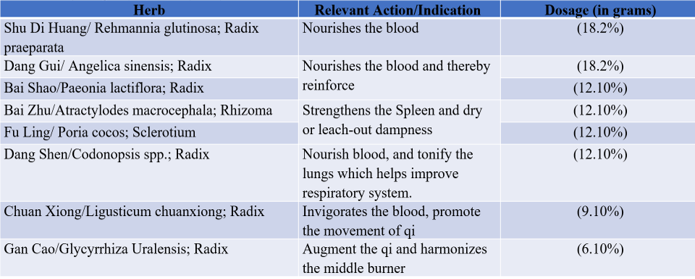
Chinese Herbal formula Ba Zhen Wan, manufacturer herbal time, daily dosage of 4 pills, 3 times per day, patient took herbs for 1 month. Add Huang Qi - Granules (100g) from manufacturer name evergreen, take 1.5 g each time, 1 to 3 times per day to dissolve in hot water.
Table 2 Herbal formula 八珍汤 Bā Zhēn Tāng Eight Treasure Decoction, (Dan Bensky, 2015).
Herbal medicine compliance avoids physical exhaustion, exposure to cold environment and foods that are pungent and spicy. Also, recommend patients to maintain a balanced diet and do social activities such as Yoga and Meditation to practice deep breathing at least 30 minutes a day. Alternative therapies such as acupuncture, massage, chiropractor 1 a week and take nutritional Turmeric supplements to support overall health.
Results
After the second treatment, the patient experienced increased appetite. Fatigue was also improved, where she felt (8 out of 10) just a little tired in the afternoon and want to take a nap. She also experienced better sleep, more energy and happy. Patient feel like she back to normal life and gain weight. After the 10 treatments, The CT scan showed interval development of a right lower lobe 5 mm solid nodule in the lung. Additional sub 6 mm pulmonary nodules were stable. No effusion or pneumothorax. Currently 06/21/22 CT scan shown patents has new pulmonary nodules and increase in size, concerning for worsening metastatic disease. The patient decided to resume chemotherapy but with the support of acupuncture and Chinese herbal medicine.
Discussion/ Conclusion
This case study showed evidence of the therapeutic use of herbal formulas and acupuncture for cancer patients. Herbal remedies and acupuncture can be helpful for cancer patients to support their quality of life as they endure the side effects and toxicity of chemotherapy treatment. When using TCM herbs in treatment of lung cancer. he treatment efficacy is obviously higher a harmonious combination with chemotherapy can increase the efficacy by 10%. Can obviously prolong the survival period, improvement in a lot of symptoms such as cough, coughing up of phlegm, fatigue, malnutrition etc. Reaching constitutional condition can mitigate chemotherapy toxin induced reactions. The most important thing to improve patients’ quality of life.\
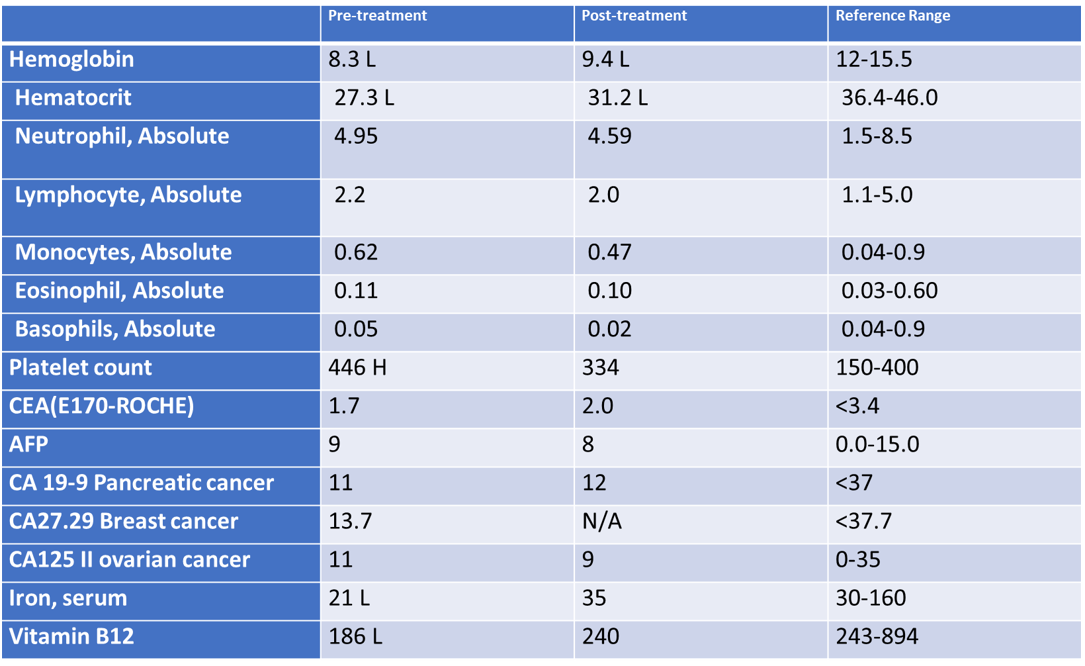
Table 3. Blood test results
Work cited
References
Dan Bensky, V. S. (2015). Chinese Herbal Medicine (2 ed.). Seattle, WA, USA: Eastland Press, Inc. Retrieved 10 07, 2021
Organization, W. H. (2022, Feb 03). Cancer. Retrieved Jul 24, 2022, from World Health Organization: https://www.who.int/news-room/fact-sheets/detail/cancer
team, T. A. (2022, Feb 14). American Cancer Society. Retrieved July 24, 2022, from American Cancer Society: https://www.cancer.org/treatment/understanding-your-diagnosis/what-is-cancer.html
Yang Zhou, W. G. (2008). Chinese herbal medicine in the treatment of lung cancer. Asian Journal of Traditional Medicines, 3(1). Retrieved 07 30, 2022
Zhang Li, Z. F. (2021). Traditional Chinese medicine and lung cancer- From theory to practice. Biomedicine & Pharmacotherapy , 1-4. doi:10.1016/j.biopha.2021.111381